
 By Admin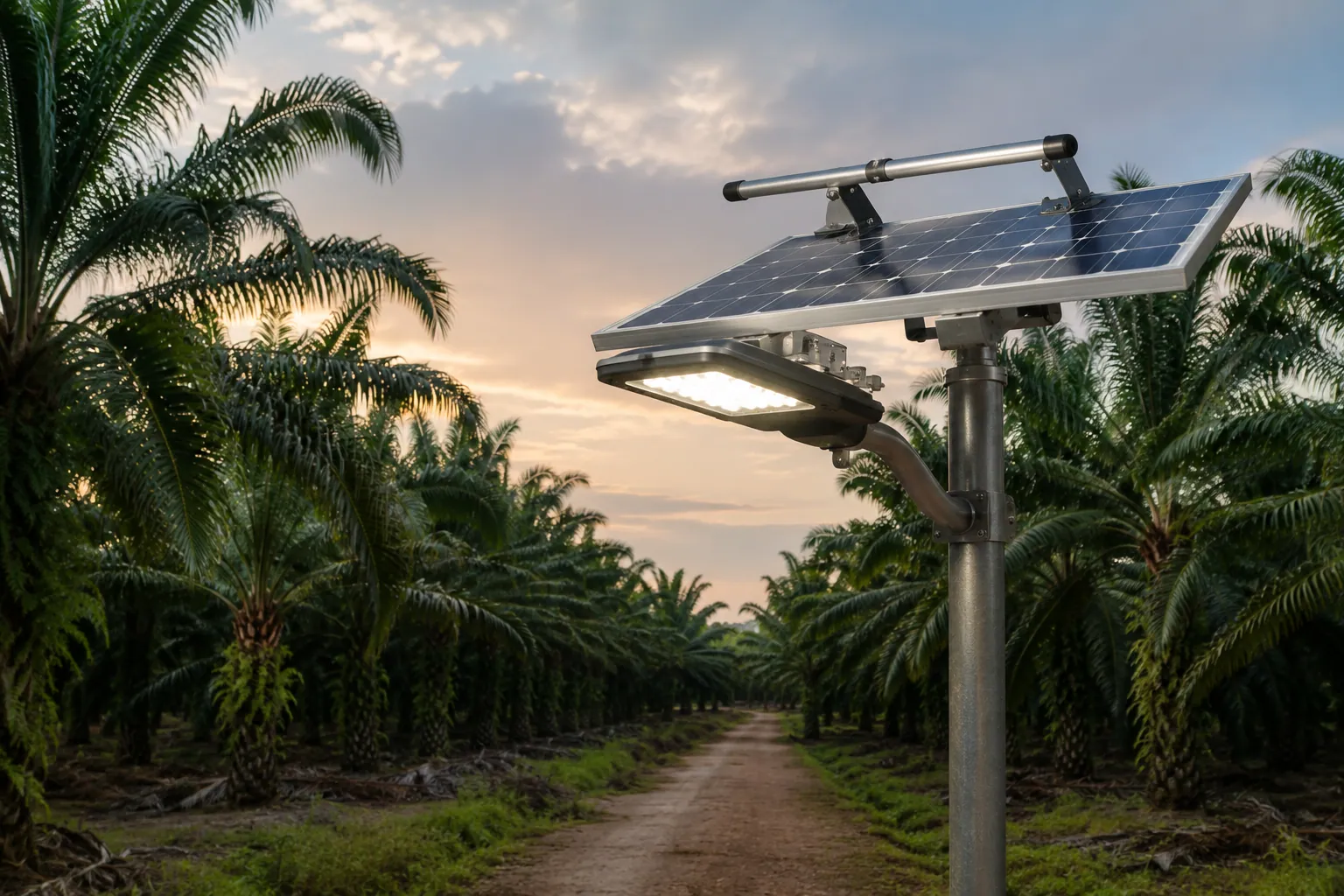
Self cleaning street light palm oil refers to a self-cleaning solar street light designed for palm oil plantations, oil palm estates, and similar tropical agricultural environments where dust, oil mist, humidity, mud, and organic residue can affect lighting performance. In simple words, it is a low-maintenance lighting solution that helps keep the solar panel or light surface cleaner so the system can charge better and provide more reliable light at night.
In palm oil areas, normal solar street lights may face more dirt than lights installed on clean city roads. Plantation roads, worker housing areas, processing areas, loading points, and perimeter zones often deal with dust buildup, oil residue, pollen, bird droppings, high humidity, and rainy-season mud. A self-cleaning system helps reduce these problems through brushes, wipers, coatings, smart cleaning cycles, or automatic cleaning mechanisms.
What Does Self Cleaning Street Light Palm Oil Mean?
The phrase self cleaning street light palm oil can sound confusing at first. It does not usually mean that the street light is made from palm oil. Instead, it usually means a self-cleaning street light system used in palm oil plantation lighting or oil palm environments.
These lights are often solar-powered. They collect sunlight during the day through a solar panel, store energy in a battery, and power an LED lamp at night. The “self-cleaning” part means the light has some feature that helps remove dirt, dust, oil mist, or debris from the solar panel or lamp surface.
This matters because palm oil regions are often hot, humid, and dusty. Some plantations are also far from the main power grid, so off-grid solar street lights are a practical choice. When the panel stays cleaner, the system can maintain better solar charging efficiency, stronger battery health, and more stable lighting.
So, when people search for what is self cleaning street light palm oil, they are usually looking for a lighting system that is suitable for plantation roads, worker housing, processing facilities, remote agricultural roads, and oil palm estate lighting.
Why Palm Oil Plantations Need Self-Cleaning Street Lights
Palm oil plantations are not like clean urban streets. They often include long roads, uneven terrain, muddy paths, heavy machinery, worker routes, loading areas, and processing zones. These places need reliable lighting for worker safety, transportation safety, security, and night-time operations.
A normal solar street light may work well in a clean area, but in a plantation environment, the solar panel can quickly collect dust, fine plant fibers, organic particles, bird droppings, oil mist, and sticky residue. Once this layer builds up, sunlight cannot reach the photovoltaic surface properly. That means lower charging, weaker battery backup, dim lights, and shorter operating hours.
This is where self-cleaning solar lights for plantation roads become useful. They reduce the need for frequent manual cleaning and help the system perform more consistently. For large plantations with dozens or hundreds of lights, this can save time, labor, fuel, and maintenance trips.
Palm oil plantations may need these lights in several areas:
- Estate access roads
- Worker housing paths
- Palm oil mill surroundings
- Processing areas
- Loading points
- Perimeter zones
- Security checkpoints
- Remote roads and bridges
- Night harvest routes
For plantation owners and project planners, the goal is simple: install a reliable lighting system that can handle dust, humidity, oil residue, rainfall, and remote conditions with less manual work.
How Self-Cleaning Solar Street Lights Work
A self-cleaning solar street light works like a normal solar street light, but with an added cleaning feature. During the day, the solar panel absorbs sunlight and converts it into electricity. That energy is stored in a lithium battery or LiFePO₄ battery. At night, the battery powers the LED light.
The self-cleaning feature helps keep the solar panel surface cleaner. Depending on the design, the system may use a mechanical brush, motorized wiper, robotic arm, hydrophobic coating, smart timer, sensor, or automatic cleaning cycle.
For example, a brush-based system may move across the solar panel at a set time each day to remove dust and debris. A wiper system may work like a car windshield wiper, clearing surface dirt after rain or during scheduled cycles. Some advanced lights may use IoT monitoring, allowing managers to track cleaning cycles, battery levels, and faults remotely.
Other systems use coatings instead of moving parts. Hydrophobic coatings help water roll off the panel surface, carrying dust with it. Photocatalytic coatings, such as TiO₂, can help break down organic residue when exposed to sunlight. Superhydrophobic surfaces and anti-soiling coatings are also used to reduce dust adhesion.
The main purpose is not to make the light completely maintenance-free. The purpose is to reduce dirt buildup and improve performance between inspections. Cleaner panels can support better energy production, panel charging, battery autonomy, and reliable lighting at night.
Active vs Passive Self-Cleaning Systems
Self-cleaning systems can be divided into two simple types: active and passive.
An active self-cleaning system uses moving parts or powered mechanisms. This may include brushes, wipers, robotic arms, vibration-based cleaning, or automated solar panel cleaning systems. Active systems are useful in places with heavy dust, sticky oil mist, dry-season dirt, or frequent debris. They can physically remove dirt from the panel surface.
A passive self-cleaning system uses material or surface technology. This may include hydrophobic coatings, hydrophilic coatings, photocatalytic coatings, anti-dust coatings, anti-reflective self-cleaning coating, or rain-assisted self-cleaning surfaces. These systems do not usually have motors or moving parts. Instead, they help dust, water, and residue slide off more easily.
Both systems can be useful. A dusty plantation road may need a brush or wiper system, while a rainy and humid plantation may benefit from a coating-based system. In many projects, the best approach is a combination of durable hardware, protective coating, good installation planning, and periodic inspection.
How Dust, Oil Mist, and Humidity Affect Solar Performance
Solar panels need clean sunlight. When the panel surface is covered with dust, oil mist, pollen, mud, bird droppings, or sticky organic residue, less sunlight reaches the photovoltaic cells. This problem is known as solar panel soiling.
In palm oil environments, soiling can be more serious because the air may carry tiny oil particles, fine plant fibers, and organic materials. Plantation roads can also produce dust during dry weather, while rainy seasons may create mud splashes, moisture marks, and sticky surface residue.
The result is lower photovoltaic performance. The light may charge more slowly during the day, the battery may not reach full capacity, and the LED may become dim earlier at night. Over time, poor charging can also place extra strain on the battery system.
This is why how dust and oil mist affect solar street lights is an important topic. Even a high-quality solar street light can perform poorly if its panel is always dirty. A self-cleaning system helps reduce sunlight blockage and supports more stable energy output.
In simple terms: a cleaner panel means better charging, stronger battery backup, and more reliable lighting.
Main Benefits of Self-Cleaning Street Lights in Palm Oil Areas
The biggest benefit of self-cleaning street lights is reduced maintenance. In a large plantation, sending workers to clean every solar panel manually can take time, fuel, and labor. If the lights are installed on tall poles, manual cleaning may also create safety risks because workers may need ladders or lifting tools.
A self-cleaning system reduces this burden. It helps control dust buildup, oil residue, debris, and surface contamination, so the system can work more efficiently between inspections.
Another major benefit is better lighting reliability. Palm oil plantations need safe roads and visible paths, especially during early morning, evening, and night operations. Reliable lighting supports worker safety, security patrols, loading activity, transportation, and productivity.
Self-cleaning lights can also reduce long-term costs. Although the upfront cost may be higher than a standard solar street light, the system may lower manual cleaning costs, travel costs, fuel use, downtime, and maintenance trips. For remote plantations, this can make a meaningful difference in the total cost of ownership.
Key benefits include:
- Better solar charging efficiency
- Lower manual cleaning needs
- More stable lighting output
- Improved safety and security
- Fewer maintenance visits
- Longer product life
- Better support for off-grid roads
- Reduced operational disruption
For plantation managers, the value is not only in the light itself. The real value is in having a system that keeps working in difficult outdoor conditions.
Where These Lights Are Used in Palm Oil Plantations
A self-cleaning solar street light can be used in many parts of a palm oil estate. The most obvious place is the plantation road. These roads need lighting for vehicles, workers, security teams, and night operations.
They are also useful near worker housing. Good lighting around housing areas can improve visibility, comfort, and safety. Processing areas and palm oil mills also need dependable lighting because they may operate during early or late hours.
Perimeter zones are another important location. Solar lighting can support security patrols and reduce dark zones around the estate. Loading points, storage areas, weighing stations, and remote bridges may also benefit from low-maintenance solar street lights.
In short, palm oil plantation lighting is not only about roads. It is about creating safer, more visible, and more reliable working areas across the entire estate.
Standard Solar Street Light vs Self-Cleaning Solar Street Light
A standard solar street light can work well in many environments. However, in dusty, humid, and oil-residue-prone areas, it may need frequent cleaning. A self-cleaning solar street light is designed to reduce that cleaning burden.
| Feature | Standard Solar Street Light | Self-Cleaning Solar Street Light |
| Cleaning | Manual cleaning needed | Built-in cleaning support |
| Best Use | Cleaner roads and normal outdoor spaces | Dusty, humid, oily, remote sites |
| Maintenance | More frequent in harsh areas | Lower cleaning frequency |
| Upfront Cost | Usually lower | Usually higher |
| Long-Term Value | Depends on easy maintenance access | Better for hard-to-reach areas |
| Performance Stability | Can drop when panel gets dirty | More consistent when cleaning works well |
The right choice depends on the site. If the light is easy to reach and the environment is clean, a standard solar street light may be enough. But if the site has dust, oil mist, sticky residues, heavy humidity, or limited maintenance access, a self-cleaning option may be more practical.
Key Features to Check Before Buying
Before buying a self cleaning street light palm oil system, check more than just the price. The cheapest option is not always the best for plantation roads.
First, check the cleaning method. Does the light use a brush, wiper, coating, robotic system, or smart cleaning cycle? Make sure the method matches the local environment. Heavy dust may need a stronger active cleaning system, while rainy areas may benefit from protective coatings.
Second, check the solar panel and battery. A good system should have a properly sized solar panel, a durable LiFePO₄ battery, and a reliable MPPT charge controller. MPPT, or Maximum Power Point Tracking, helps the system manage solar energy more efficiently.
Third, check durability. Look for corrosion-resistant materials, sealed housings, galvanized steel poles, aluminum housing, and suitable weather protection. For plantation conditions, an IP65-rated component may be acceptable in some cases, but many buyers also look for IP66 or IP67 protection depending on exposure to rain, mud, and dust.
Other useful features include:
- PIR motion sensor
- Adaptive dimming schedule
- Remote monitoring
- Smart fault alerts
- Battery management system
- Strong pole foundation design
- Spare parts availability
- Local technical support
- Warranty coverage
A good self-cleaning solar street light should be strong enough for the site, not just bright enough on paper.
Installation, Maintenance, and Inspection Tips
Proper installation is just as important as product quality. Even the best solar street light can perform badly if it is installed under shade, at the wrong angle, or in a weak foundation.
Before installation, the site should be assessed carefully. Project planners should check road width, pole height, spacing between lights, solar panel direction, shade from palm trees, terrain, drainage, wind exposure, and average daily sunlight. In some remote areas, battery backup must also be sized for cloudy days or rainy seasons.
Maintenance is still needed, even with self-cleaning technology. A self-cleaning light reduces cleaning work, but it does not remove the need for inspection. Plantation teams should check the solar panel, cleaning motor, LED output, battery health, controller, wiring, pole condition, and foundation.
A practical maintenance plan may include quarterly visual inspections or checks every three to six months, depending on dust, humidity, and local conditions. Areas with heavy oil mist or dry-season dust may need more frequent checks.
A simple rule works well: self-cleaning means less cleaning, not zero maintenance.
Cost Factors and Long-Term Value
The price of self cleaning street light palm oil systems depends on many factors. These include wattage, solar panel size, battery capacity, cleaning mechanism, pole height, IP rating, smart monitoring, installation conditions, shipping, project size, and warranty.
A small system for a simple road may cost less than a heavy-duty system with IoT monitoring, a large battery, corrosion-resistant materials, and a strong cleaning mechanism. Bulk installation can also affect cost per unit.
The important point is to look at long-term value, not only upfront cost. A cheaper light may become expensive if it needs frequent cleaning, battery replacement, or field visits. A better self-cleaning system may reduce labor cost, travel cost, downtime, and maintenance trips.
Smart Monitoring, Hybrid Options, and Sustainability Benefits
Many modern solar street lights now include smart monitoring. This allows plantation managers to track battery levels, panel charging, cleaning cycles, faults, and lighting performance without visiting every pole. Some systems may use 4G/LTE, LoRa-MESH, RS485, PLC, NEMA IoT, or ZHAGA IoT solutions.
Remote monitoring is especially useful in large plantations because lights may be spread across long distances. Smart fault alerts and predictive maintenance can help teams fix small issues before they become major failures.
In some areas, a wind-solar hybrid street light system may also be useful. If a site has frequent cloudy weather but steady wind, hybrid street lights can use both solar panels and wind turbines. This is not necessary for every palm oil plantation, but it can be useful in remote areas with limited grid access.
There is also a sustainability benefit. Solar-powered street lights reduce dependence on diesel generators and grid electricity. They can support renewable energy, rural electrification, ESG plantation infrastructure, carbon reduction, and sustainable palm oil infrastructure. If a plantation is working toward sustainability goals or RSPO-related standards, renewable lighting can support broader environmental planning.
Common Mistakes to Avoid Before Buying
One common mistake is choosing the cheapest light without checking the environment. A normal solar street light may not be enough for areas with dust, oil mist, humidity, mud, and remote access problems.
Another mistake is ignoring battery backup. Plantation lighting must work through cloudy weather and rainy seasons. If the battery is too small, the light may fail when it is needed most.
Some buyers also ignore pole quality. Weak materials can corrode, bend, or fail in harsh outdoor conditions. A good pole should match the wind load, soil condition, and installation site.
Other mistakes include installing panels under palm shade, ignoring spare parts, skipping local support, choosing the wrong IP rating, and assuming self-cleaning means no inspection.
Before buying, use this quick checklist:
- Does the cleaning system match the site conditions?
- Is the battery suitable for remote operation?
- Is the pole corrosion-resistant?
- Is the IP rating suitable for rain, dust, and mud?
- Is there remote monitoring?
- Are spare parts available?
- Is there a clear maintenance plan?
- Is the system suitable for palm oil plantation roads?
A little planning before purchase can prevent years of lighting problems.
Quick FAQ About Self Cleaning Street Light Palm Oil
What is self cleaning street light palm oil?
Self cleaning street light palm oil usually means a self-cleaning solar street light used in palm oil plantation environments. It is designed to reduce dust, oil residue, and debris buildup on the solar panel or light surface.
Is palm oil used to make the street light?
Usually, no. The phrase mostly refers to the application area, meaning palm oil plantations or oil palm estates. It does not usually mean the light is made from palm oil.
How does a self-cleaning solar street light clean itself?
It may use brushes, motorized wipers, robotic arms, hydrophobic coatings, sensors, timers, or smart cleaning cycles to reduce dirt and dust on the panel surface.
Why do palm oil plantations need self-cleaning solar lights?
Palm oil plantations often have dusty roads, oil mist, humidity, mud, organic residue, and remote access routes. These conditions can reduce solar charging and increase maintenance needs.
Are self-cleaning solar street lights worth the cost?
They can be worth it where manual cleaning is difficult, labor costs are high, or lights are installed across large remote areas. The higher upfront cost may be balanced by lower maintenance and better system reliability.
Do these lights still need maintenance?
Yes. They reduce cleaning work, but they still need periodic inspection, battery checks, controller checks, and structural maintenance.
What battery is best for solar street lights in remote areas?
A LiFePO₄ battery is commonly preferred because it is durable, stable, and suitable for repeated charging cycles in solar lighting systems.
What IP rating is best for plantation solar street lights?
Many outdoor lights use IP65-rated components, but harsher plantation environments may require IP66 or IP67 protection, depending on rain, dust, mud, and exposure.
Conclusion
Self cleaning street light palm oil is best understood as a low-maintenance solar lighting solution for palm oil plantations and other tough agricultural environments. It helps solve a real problem: solar panels and lamp surfaces can become dirty because of dust buildup, oil mist, humidity, bird droppings, mud, and organic residue.
The main benefit is simple. A cleaner solar panel can charge better, support stronger battery backup, and provide more reliable lighting at night. These systems can improve worker safety, plantation security, transportation visibility, and long-term operational efficiency.