
 By Admin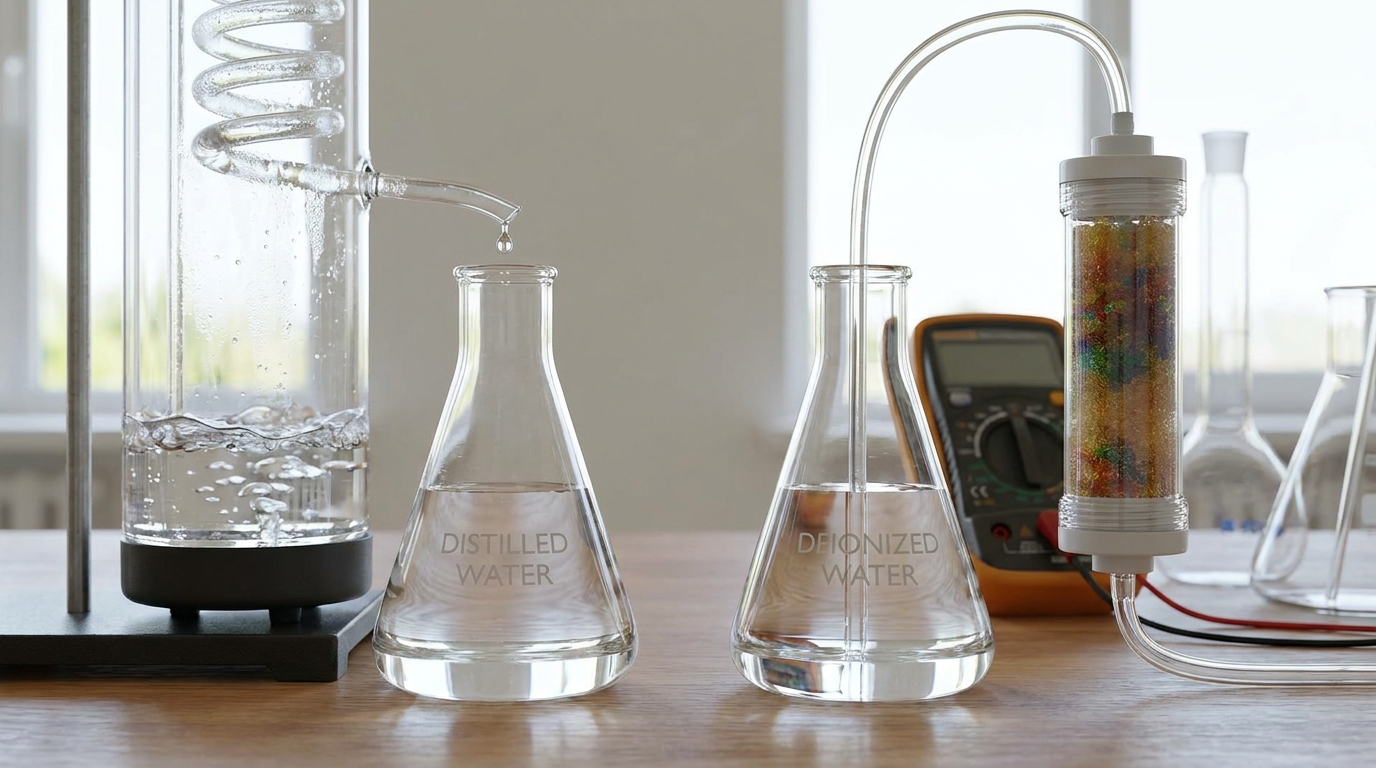
No, deionized water and distilled water are not the same, even though both are types of purified water. They are made in different ways, remove different impurities, and are used for different purposes.
The confusion is understandable because both waters are often described as pure water, mineral-free water, or high purity water. However, deionized water, also called DI water, is usually made through ion exchange, which removes charged mineral ions like calcium, magnesium, sodium, chloride, and sulfate. Distilled water is made through boiling and condensation, where water turns into steam and then cools back into liquid.
The best choice depends on how you plan to use it. For example, distilled water is commonly used in CPAP machines, humidifiers, and steam irons, while deionized water is often used in labs, electronics cleaning, industrial manufacturing, and spot-free rinsing.
Is Deionized Water the Same as Distilled Water?
Deionized water is not the same as distilled water, but they are similar because both have had many minerals removed. The key difference is the water purification process.
Deionized water is treated to remove charged particles, also called ions. These include minerals and salts that can affect electrical conductivity, leave mineral residue, or cause water spots. Because of this, DI water is often used where low mineral content matters, such as in laboratories, electronics, batteries, and industrial systems.
Distilled water, on the other hand, is made by heating water until it becomes steam. The steam is then collected and cooled into liquid water. This process leaves many dissolved solids, minerals, and impurities behind.
So, when people ask, “is deionized water the same as distilled water?”, the short answer is: No. They are both purified, but they are purified differently.
A simple way to remember it is this:
Deionized water removes ions. Distilled water is made from steam.
That difference matters because one may be better than the other depending on whether you need water for drinking, appliances, cleaning, medical devices, aquariums, or technical work.
Deionized Water vs Distilled Water: Quick Comparison
Here is a simple comparison of deionized water vs distilled water:
| Feature | Deionized Water | Distilled Water |
| Main process | Ion exchange | Boiling and condensation |
| Also called | DI water, demineralized water | Steam-distilled water |
| Removes | Charged mineral ions | Many minerals and dissolved solids |
| Common minerals removed | Calcium, magnesium, sodium, chloride, sulfate | Calcium, magnesium, salts, many dissolved solids |
| May not fully remove | Bacteria, microbes, VOCs, organic compounds | Some volatile organic compounds if not properly treated |
| Common uses | Labs, electronics, car rinsing, industry | CPAP machines, humidifiers, irons, appliances |
| Drinking use | Only if labeled potable or food-grade | Generally safe, but lacks minerals |
| Taste | Flat or neutral | Flat or neutral |
| Key measurement | Conductivity and resistivity | TDS and purity level |
Both types of water can have low total dissolved solids, also called TDS, but the final quality depends on the equipment, storage, and intended use. Neither label automatically means the water is perfect or safe for every purpose.
What Is Deionized Water?
Deionized water is water that has had charged mineral ions removed. It is commonly called DI water. The process used to make it is called deionization, and it usually works through ion-exchange resin or resin beds.
Water naturally contains dissolved minerals. These minerals may include calcium, magnesium, sodium, iron, chloride, and sulfate. In water chemistry, many of these minerals exist as charged particles. Some are positive ions, also called cations, and others are negative ions, also called anions.
During ion exchange, the water passes through special resin. The resin attracts and removes these charged particles. In many systems, the resin exchanges unwanted ions for H+ and OH-, which can combine to form H2O.
This process creates water with very low mineral content and low electrical conductivity. That is why deionized water is valuable for precision work, laboratory applications, electronics production, and industrial processes.
However, deionization mainly targets ions. It does not automatically mean the water is sterile, food-safe, or free from every possible contaminant.
What Is Distilled Water?
Distilled water is water that has been purified through distillation. In simple terms, water is boiled until it turns into steam. The steam rises, is collected, and then cools back into liquid water. This new liquid is called distilled water.
The idea behind water distillation is that many minerals, salts, and dissolved solids do not travel with the steam. They are left behind in the original container. This makes distilled water low in minerals and useful for many household and medical-related appliances.
Distilled water is often used in:
- CPAP machines
- Humidifiers
- Steam irons
- Medical equipment
- Car batteries
- Aquariums, when properly managed
- Household appliances that need low-mineral water
Because distilled water has very few minerals, it often has a flat taste or neutral taste. Some people drink it, while others prefer filtered or mineral-containing drinking water.
The important point is that distilled water is not the same as deionized water. It is made through heat, steam, and condensation, not ion-exchange resin.
How Deionized and Distilled Water Are Made
The biggest difference between distilled water vs deionized water is how each one is made.
Deionized water is made by passing water through DI resin, mixed bed resin, or resin beds. These resins remove charged mineral ions from the water. Many advanced systems use reverse osmosis before deionization. This is sometimes called an RO/DI system. Reverse osmosis helps remove many contaminants first, and deionization then reduces remaining ions.
This can make DI water very useful where low conductivity is important. For example, electronics manufacturers, labs, and pharmaceutical industries often care about conductivity, resistivity, and purity standards.
Distilled water is made through heat. Water is boiled, steam is collected, and the condensed steam becomes distilled water. This process can remove many minerals and dissolved solids, but it may be slower and more energy-intensive than some other methods.
In short:
Deionization uses resin. Distillation uses steam.
That simple difference explains why the two waters are not always interchangeable.
What Each Type of Water Removes
Both deionized and distilled water remove minerals, but they do not remove impurities in the exact same way.
Deionized water removes charged mineral ions. These include calcium, magnesium, sodium, chloride, sulfate, iron, and other dissolved mineral salts. This makes it helpful when you want to avoid mineral buildup, water spots, or electrical conductivity.
However, deionization alone may not fully remove bacteria, microbes, pathogens, organic compounds, or volatile organic compounds, also called VOCs. For higher purity, DI water is often combined with reverse osmosis, carbon filtration, UV treatment, or other purification methods.
Distilled water removes many minerals and dissolved solids because they are left behind during boiling. It can also reduce many microbes because of the heat process. However, some volatile chemicals may evaporate with the steam if the distillation system is not designed to remove them properly.
This is why it is important not to assume that every bottle of “pure water” is the same. The final water quality depends on the full treatment process, storage container, and product standard.
Can You Drink Deionized or Distilled Water?
This is one of the most common questions people ask when comparing deionized water vs distilled water.
Distilled water is generally safe to drink, but it does not contain the minerals found in regular drinking water. Since many people get minerals from food, drinking distilled water occasionally is not usually a problem for healthy adults. However, because it lacks minerals, it can taste flat and may not be the best long-term daily drinking choice for everyone.
Deionized water is different. You should not automatically drink deionized water unless it is clearly labeled as potable, food-grade, or safe for drinking. Many DI water products are made for labs, factories, batteries, cleaning, or industrial equipment. These products may not be produced, packaged, or stored under drinking-water standards.
This is especially important with lab-grade deionized water or industrial deionized water. It may be very low in minerals, but that does not mean it is safe to drink.
A helpful rule is:
Distilled water may be drinkable if sold for that purpose. Deionized water should only be consumed if the label clearly says it is safe to drink.
For regular hydration, most people are better served by clean drinking water, filtered water, or another water source intended for human consumption.
Can You Use Deionized Water Instead of Distilled Water?
Sometimes, yes — but not always. Whether you can use deionized water instead of distilled water depends on the purpose.
For many cleaning and technical uses, deionized water can work very well. It is often used for electronics cleaning, window cleaning, car detailing, and spot-free rinse systems because it leaves fewer minerals behind. It can also be useful in batteries, labs, and industrial processes where low mineral content is required.
However, if a device specifically says to use distilled water, you should be careful before replacing it with DI water. This is especially true for CPAP machines, humidifiers, and medical devices. Manufacturer instructions matter because the product may be designed, tested, or approved with distilled water in mind.
For example, if a CPAP machine manual says to use distilled water, do not assume industrial DI water is a safe replacement. The water may be low in minerals, but it may not be packaged for medical or household use.
So, are deionized and distilled water interchangeable? Only in some situations. For appliances, medical devices, and drinking, always check the label and instructions first.
Can You Use Distilled Water Instead of Deionized Water?
You may also wonder if you can use distilled water instead of deionized water. Again, the answer depends on the use.
For simple household tasks, distilled water may work as a substitute. For example, if you need low-mineral water for a steam iron, humidifier, or general cleaning task, distilled water is often a practical choice.
But in technical settings, distilled water may not always replace DI water. Labs, pharmaceutical applications, electronics production, and precision manufacturing may require water with very low conductivity or a specific resistivity level. In those cases, the water must meet a defined purity standard.
For example, a lab may require DI water because dissolved ions can affect test results. Electronics cleaning may require water that leaves almost no mineral residue. In these cases, distilled water may not be pure enough unless it has been further treated or tested.
The best answer is: distilled water can replace deionized water for some basic uses, but not for every technical or industrial use.
Best Uses for Deionized Water and Distilled Water
Both waters are useful, but they are usually chosen for different reasons.
Deionized water is often best when minerals, ions, conductivity, or residue are the main concern. It is commonly used for laboratory work, electronics cleaning, pharmaceutical industries, cooling systems, manufacturing electronics, and industrial manufacturing. It is also popular for car detailing because it can help reduce water spots during rinsing.
Distilled water is often better for common household and appliance uses. It is widely used in CPAP machines, humidifiers, steam irons, medical equipment, and some car batteries. Since it has low mineral content, it can help reduce limescale, white dust, and mineral buildup in appliances.
Here is a practical decision table:
| Use Case | Better Choice | Why |
| CPAP machine | Distilled water | Commonly recommended for humidifier chambers |
| Humidifier | Distilled water | Helps reduce white dust and mineral buildup |
| Steam iron | Distilled water | Helps reduce scale and clogging |
| Car battery | Distilled water or specified battery water | Low minerals help protect the battery |
| Electronics cleaning | Deionized water | Low conductivity and low residue |
| Window cleaning | Deionized water | Helps prevent water spots |
| Lab work | Deionized or lab-grade water | Depends on purity requirements |
| Aquarium | Depends | Pure water may need remineralization |
| Plants | Depends | Some plants may need minerals |
| Drinking | Potable water only | Must be labeled safe to drink |
The key lesson is that the best water depends on the job.
Deionized vs Purified vs Reverse Osmosis vs Sterile Water
Many people also confuse deionized water, distilled water, purified water, reverse osmosis water, and sterile water.
Purified water is a broad term. It can include water treated by distillation, deionization, reverse osmosis, filtration, or other methods. So, distilled water and deionized water can both be types of purified water, but purified water is not always distilled or deionized.
Reverse osmosis water, also called RO water, is made by pushing water through a membrane that removes many dissolved substances. RO water is often used in drinking water systems and can also be used before DI resin in an RO/DI setup.
Sterile water is different. It is treated and packaged for specific medical or laboratory uses. Sterile water is not the same as distilled water unless the label says so.
Demineralized water is often used as a similar term to deionized water because both refer to water with minerals removed. In the UK and other regions, people may use the spelling deionised water or demineralised water.
Understanding these terms helps prevent mistakes. The label matters more than the general name.
TDS, Conductivity, and Purity Explained Simply
When comparing DI water vs distilled water, you may see terms like TDS, conductivity, and resistivity.
TDS means Total Dissolved Solids. It refers to dissolved minerals, salts, and other substances in water. Lower TDS usually means fewer dissolved solids.
Conductivity measures how easily water carries electricity. Water with more dissolved ions usually has higher conductivity. Since deionized water has many ions removed, it often has very low conductivity.
Resistivity is closely related to conductivity. High resistivity usually means the water has very few ions. This is important in labs, electronics production, and high-purity industrial systems.
For normal home use, you do not always need to measure these numbers. But for scientific applications, pharmaceutical work, or electronics cleaning, they can matter a lot.
In simple words:
More ions usually mean higher conductivity. Fewer ions usually mean purer water for technical use.
Common Mistakes to Avoid
One common mistake is assuming deionized water and distilled water are identical. They are not. They may look the same, but the purification methods and best uses are different.
Another mistake is drinking industrial deionized water or lab-grade DI water without checking whether it is food-safe. Low minerals do not automatically mean safe for drinking.
People also sometimes use the wrong water in appliances. If your CPAP machine, humidifier, or medical device says to use distilled water, follow the manufacturer’s instructions. Do not replace it with another type of water unless the manufacturer says it is acceptable.
Aquariums are another area where people make mistakes. Pure water may lack the minerals fish and plants need. Distilled or deionized water may need remineralization before being used in an aquarium.
Finally, do not assume “more pure” always means “better.” Water that is excellent for electronics cleaning may not be ideal for drinking. Water that works for a steam iron may not meet lab purity standards.
Final Verdict: Which One Should You Choose?
The final answer is simple: deionized water and distilled water are not the same, and one is not automatically better than the other.
Choose distilled water when you need water for common household appliances such as CPAP machines, humidifiers, steam irons, and certain medical-related devices. It is easy to find, widely used, and often recommended for reducing mineral buildup.
Choose deionized water when you need low-mineral, low-conductivity water for labs, electronics cleaning, spot-free rinsing, industrial processes, pharmaceutical applications, or technical work.
For drinking, choose water that is clearly labeled safe for human consumption. For appliances and medical devices, follow the product instructions. For labs or industry, follow the required purity standard.
In short: distilled water is often best for household appliances, while deionized water is often best for technical and industrial uses.
FAQs About Deionized and Distilled Water
Is deionized water the same as distilled water?
No. Deionized water is made by removing charged ions through ion exchange. Distilled water is made by boiling water and condensing the steam. Both are purified, but they are not the same.
Can I use deionized water instead of distilled water?
Sometimes, but not always. Deionized water may work for cleaning, electronics, and some technical uses. For CPAP machines, humidifiers, and medical devices, follow the manufacturer’s instructions.
Can I use distilled water instead of deionized water?
For basic household tasks, yes, distilled water may work. For labs, electronics production, or precision work, distilled water may not meet the required purity standard.
Is deionized water safe to drink?
Only drink deionized water if it is labeled potable, food-grade, or safe for drinking. Industrial or lab-grade deionized water should not be assumed safe to drink.
Is distilled water safe to drink?
Distilled water is generally safe to drink if it is sold for drinking or household use. However, it lacks minerals and may taste flat.
Does deionized water remove bacteria?
Deionization mainly removes charged mineral ions. It does not automatically remove all bacteria, microbes, pathogens, or organic compounds.
Does distilled water remove minerals?
Yes. Distillation removes many minerals and dissolved solids because they are left behind when water turns into steam.
Which is better for a humidifier?
Distilled water is usually better for humidifiers because it helps reduce white dust, limescale, and mineral buildup.
Which is better for a car battery?
For many car batteries, distilled water or specified battery water is commonly used because it has low mineral content. Always follow the battery manufacturer’s instructions.
Is deionised water the same as deionized water?
Yes. Deionised water is the UK spelling of deionized water. Both terms refer to water that has had charged ions removed.
Disclaimer: This content is for general informational purposes only and should not be considered professional, medical, or technical advice. Always verify details with qualified experts or manufacturers before making decisions involving water use, safety, or equipment specifications. when absolutely necessary